
How Much Does a Bail Bond Cost in San Bernardino County?
Learn how San Bernardino County bail bond costs are calculated, what to ask about fees and collateral, and how to review a written quote.
How Much Does a Bail Bond Cost in San Bernardino County?
A bail bond in San Bernardino County generally costs a percentage of the court-set bail amount, not the full bail amount. Trinity Bail Bonds’ website explains that the standard premium is generally 10% of the bail amount. In qualifying situations, an approved discount may reduce the rate to as low as 7%. The exact amount you pay depends on the bail set in the case, the approved premium, any disclosed additional charges, collateral requirements, and the payment terms in your agreement.

For example, if bail is set at $25,000, a 10% premium would be $2,500. At a 7% rate, the premium would be $1,750 if the case qualifies and the rate is approved. Those figures illustrate the percentage calculation; they are not a quote for a particular case. Before signing anything, ask for the total amount due, the payment schedule, whether collateral is required, and which payments or fees are refundable.
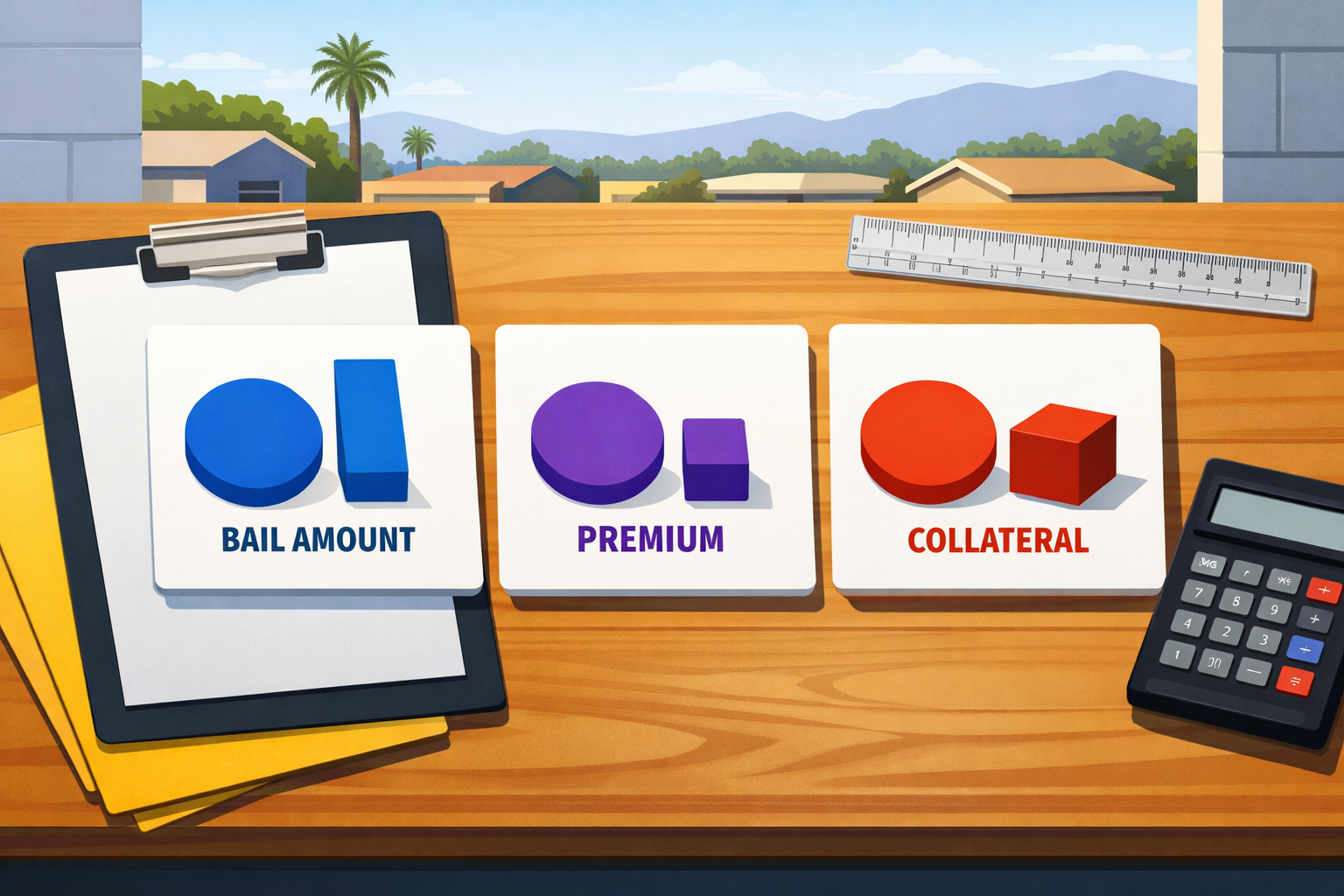
What Makes Up the Cost of a San Bernardino County Bail Bond?
The first step is separating two numbers that are often confused: the court’s bail amount and the bail bond premium. The court sets bail based on the case and applicable court requirements. A bail bond agency then charges a premium for posting a bond on the defendant’s behalf. The premium is calculated from the bail amount, so a higher court-set bail usually means a higher bond cost.
A bail bond is not the same as paying cash bail directly to the court. With cash bail, the person posting bail may need to provide the full court-set amount and then follow the court’s rules for any return. With a bond, the agency provides the financial guarantee to the court, while the signer pays the agency’s premium and accepts the obligations in the agreement. Ask the agent to explain the difference for your situation before choosing an option.
Start with the court-set bail amount
You cannot calculate the premium accurately until you confirm the current bail amount. A person arrested in San Bernardino County may be held at a facility such as West Valley Detention Center in Rancho Cucamonga, Central Detention Center in San Bernardino, Glen Helen Rehabilitation Center in Devore, or another local facility. Confirm the booking information and bail amount through the appropriate jail or court source because the amount can change after a court hearing or other case action.
Do not assume that the city of arrest determines the price by itself. Fontana, Ontario, Chino, Rancho Cucamonga, Rialto, and other San Bernardino County locations may involve different facilities or case details, but the key starting point for a quote is the bail amount actually set in the case. Also ask whether a hold, warrant, probation matter, or other restriction could prevent release even after the financial bail requirement is addressed.
Apply the premium percentage carefully
The website information for Trinity Bail Bonds describes a standard premium generally equal to 10% of the bail amount, with qualifying approved discounts potentially reducing the rate to as low as 7%. The percentage should be applied to the bail amount, not to a guessed monthly payment or down payment. If bail is $10,000, a 10% premium calculation is $1,000; a 7% calculation is $700 if the case qualifies for that rate.
These examples show the math only. They do not establish that every case qualifies for a discount or that every applicant will receive the same terms. Ask the licensed agent to state the approved percentage in writing and identify the amount due at signing. If someone quotes a rate without explaining whether it is a standard premium, a discount, or a payment-plan arrangement, request clarification before providing payment information.
Ask about fees, collateral, and refunds
The premium may not be the only item discussed during an application. Ask whether the quote includes every disclosed fee connected with the bond, whether collateral is required, and what happens to collateral when the bond is discharged. Trinity Bail Bonds’ website says collateral is not always required and that requirements can depend on the case and bail amount. That means you should not assume either that collateral is always necessary or that it can never be requested.
Ask specifically which payments are nonrefundable. The premium for a bail bond is generally treated differently from collateral, and a payment plan does not automatically change the total premium. Request a written breakdown showing the bail amount, premium percentage, total premium, amount due today, remaining balance, payment dates, collateral terms, and any separately listed charges. If the paperwork is unclear, pause and ask for an explanation in plain language.
How to Compare and Plan for the Total Cost
The lowest initial payment is not necessarily the lowest total cost. A small down payment may make release more manageable, but the remaining balance still has to be paid according to the agreement. A useful comparison is to look at both the amount due now and the full financial obligation over the life of the bond. This is especially important when a family is making a decision under time pressure.

Use the quote worksheet below to compare actual written terms rather than relying on general percentages or promises. Keep a copy of the agreement, receipts, and payment schedule. If the defendant misses a required court appearance, the signer may face additional consequences under the contract, so the cost decision should include the responsibility of helping the defendant meet every court requirement.
Use a simple quote worksheet
Write down these figures before deciding: the current court-set bail amount; the approved premium percentage; the calculated total premium; the amount required immediately; each future payment and its due date; any disclosed fees; the collateral being offered, if any; and the conditions for returning collateral. Then add the initial payment and all scheduled future payments to confirm the total amount the family expects to pay the agency.
For a hypothetical example, suppose bail is set at $40,000 and the written quote uses a 10% premium. The premium calculation would be $4,000. If the agreement requires $1,000 at signing and four later payments of $750, the scheduled payments total $4,000. This example does not add invented fees or predict a particular offer; it demonstrates how to check whether the installment schedule matches the stated premium.
Compare cash bail with a bond
A bond can reduce the amount of money the family must provide upfront because the agency posts the larger bail amount, but the premium is the cost of that service and is generally not the same as a refundable deposit. Cash bail may require much more money at the start, while a bond may involve a premium, payment obligations, and possible collateral. The better option depends on the family’s available funds, the court’s requirements, and the terms explained by the responsible agency or court.
Ask what happens if the case ends, bail is lowered, the defendant is returned to custody, or the bond is discharged. Do not assume that a lower bail amount automatically creates a matching refund or that ending the case immediately cancels every contractual obligation. The written agreement controls the financial details, so review it carefully and ask questions before signing.
Check payment terms before signing
Trinity Bail Bonds states that it offers flexible payment plans and low down payments, but the exact plan must be confirmed for the individual application. Ask whether the payment plan changes the total premium, whether there are late-payment consequences, and whether the payment method creates any separate charge. Confirm the due dates in writing instead of relying on a verbal promise made during a stressful call.
Also ask who is responsible for keeping the defendant informed about court dates and release conditions. A bail bond does not remove the obligation to attend scheduled hearings. Missing court can create serious problems for the defendant and the signer, including possible recovery or forfeiture issues. If the release process is delayed by booking, holds, warrants, or court review, ask what is known rather than relying on an exact release-time promise.
San Bernardino County Bail Bond Cost FAQ
What is the usual bail bond premium in San Bernardino County?
Trinity Bail Bonds states that the standard premium is generally 10% of the court-set bail amount. In qualifying situations, an approved discount may reduce the rate to as low as 7%. Ask for the approved percentage and total in a written quote.
How much would a $25,000 bail bond cost?
At a 10% premium, the calculation would be $2,500. At 7%, it would be $1,750 if the case qualifies for that approved rate. These are calculation examples, not a guaranteed quote, and other disclosed terms may apply.
Is the bail bond premium refundable?
Ask the agent to explain refund rules before signing. The premium and collateral are different parts of a bail agreement, and a payment plan does not automatically make the premium refundable. Review the written contract and keep your receipts.
Do I need collateral for a San Bernardino County bail bond?
Not always. Trinity Bail Bonds’ website says collateral requirements can depend on the case and bail amount. Ask whether collateral is required, what form it may take, and the conditions for its return.
Can I pay a bail bond in installments?
Trinity Bail Bonds states that it offers flexible payment plans and low down payments. The exact amount due at signing, future installments, total premium, and payment deadlines must be confirmed in the written agreement for the specific case.